Popular blog posts
Recent forum posts
Discussion Forum
Discussion forumThe circles of life
Post #: 322
Post type: Blog post
Date: 2026-04-06 00:13:46.000
Author: Jeremy Reimer
Tags: computer history
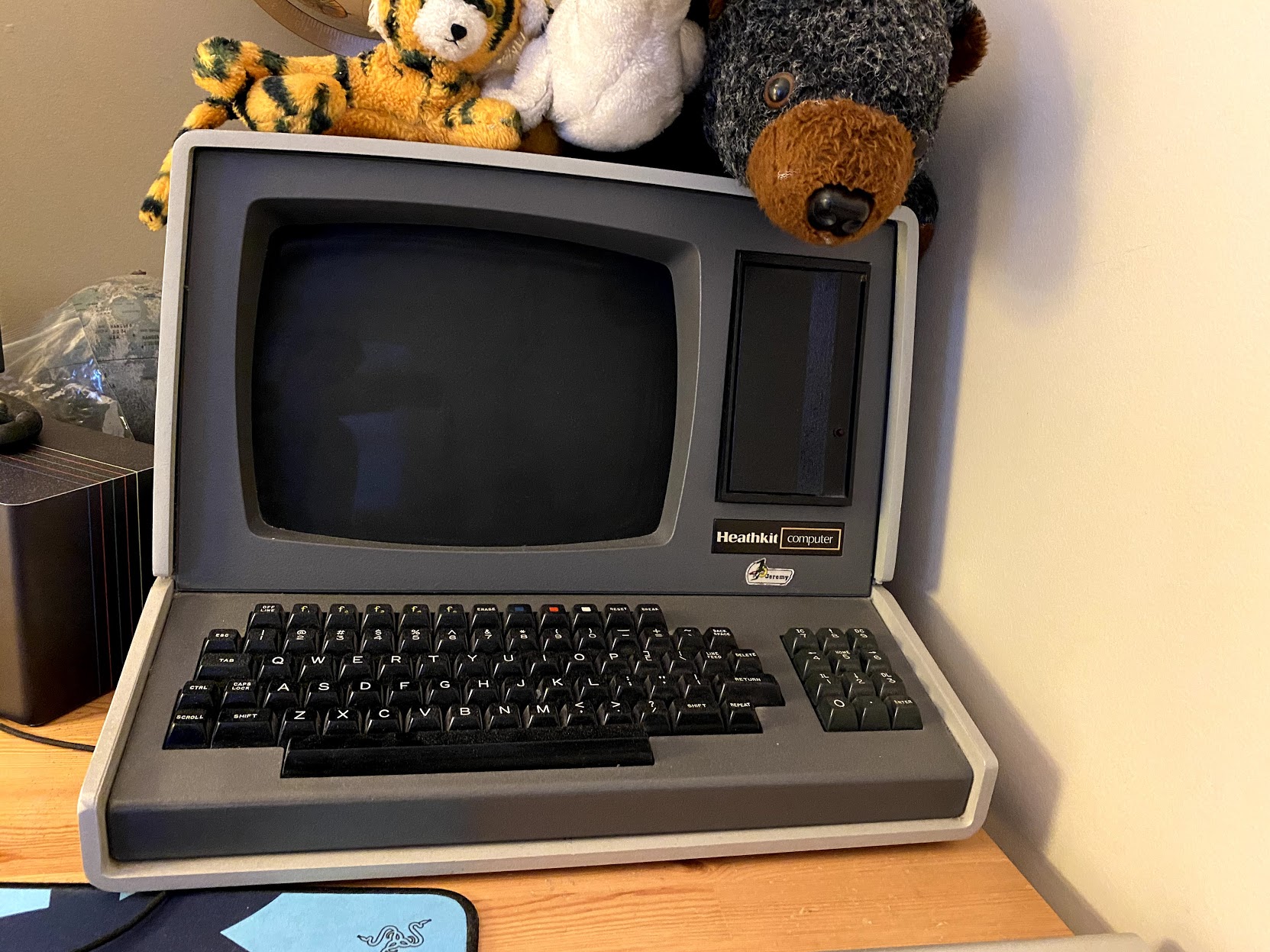
The most magical moment of my life was on Christmas Day, 1979. I was seven years old, and our family was visiting Uncle Allan’s house in Burnaby. I had been playing on the Heathkit H-89 computer for hours when my dad said it was time to go home. I pleaded with him for more time with my uncle’s magical machine. I still remember him smiling at me and explaining that what I had been obsessed with all evening was in fact my computer.
I loved that computer to bits, even as the years went on and technology started to pass it by. It was a great computer for text, with its sharp, 80-column white phosphor screen and clear upper and lower-case characters. But it did not have bitmapped graphics. Instead, you had a special graphics mode, where lower-case letters became various symbols: lines, boxes, triangles, and so forth. It was enough to make simple games, but I yearned for control over individual pixels.
In 1983, my uncle was visiting our house in Gibsons, and he brought with him an amazing new computer that he had built from a kit. It was a Heath/Zenith H-120, an impressive battle station of a machine. It had not one but TWO microprocessors: an Intel 8085 to run 8-bit software like CP/M, and a sparkling new 8088 that ran 16-bit applications like CP/M-86 and Z-DOS. The latter was a version of Microsoft MS-DOS customized for the Heath/Zenith 100 and 120 computers. It was not an IBM compatible machine. It was superior to IBM and the clones’ offerings. And it was beautiful:
For one thing, it had way better graphics modes. To make any graphics at all on an IBM PC in 1983 you had to buy a CGA card, which could manage 640 x 200 pixels but only in black and white, or 320 x 200 with four hideous colors. Usually they were cyan, magenta, white, and black. Clever programmers could swap those with red, green, yellow, and black, but that was only slightly better.
The H-120, however, had 640 x 225 bitmapped graphics in 8 glorious colors. This was so much better than CGA that early versions of AutoCAD were developed specifically for these computers.
Z-DOS shipped with Z-BASIC, a version of Microsoft BASIC tailored for the Heath/Zenith 100 and 120. It had built-in commands to draw, with pixel-perfect accuracy, points, lines, and circles.
I only had this wonderful computer for a day, so I didn’t have a chance to get too deep into manipulating individual pixels to make bitmap designs. But oh boy, did I have fun with circles.
Seeing those circles pop up in any location just mesmerized me. It was like my Heathkit H-89, only faster, and with added pixel magic.
I was so taken with drawing circles that, once my uncle had gone and taken his new computer with him, I tried my best to make a circle program in BASIC on my character-mode-only H-89. It worked. Sort of.
I could place character-mode circles in different part of the screen, in black, white, grey, and outline, in five discrete sizes. When I ran the program again in an emulator, I realized that I never even bothered to finish the size five grey circle. It was just too disappointing compared to the magic of the H-120’s beautiful pixels.
Anyway, that was it for circles for me. At least for another forty-three years or so.
In the last few months, I’ve been working on a secret project. It’s hard to even explain what it is. I wanted to blend together my fond memories of childhood computing with my more recent love of the LISP programming language. I wanted something that was easy and fun for making games, just like BASIC was all those decades ago.
The work is progressing slowly. I had to learn all sorts of nonsense about C and how pointers worked. I had to learn how to parse arbitrarily-complicated lists into pairs of cells that all pointed to each other. Many times the whole effort seemed too difficult, too impossible to even attempt. But I kept going.
Last week, I added a new instruction to my graphical LISP programming engine. It creates circles.
I feel like a little kid again, wondering at the power of pixels, amazed at what computers can do.
It’s a good feeling.
View this post in the forums
Views: 30